If you have ever walked through Los Feliz and felt like every block tells a different design story, you are not imagining it. This neighborhood rewards a close look, especially if you care about architecture, original details, and the way a home sits on its lot. Whether you are buying, selling, or simply learning the landscape, this guide will help you read Los Feliz with a sharper eye. Let’s dive in.
Why Los Feliz Feels So Distinct
Los Feliz is not defined by one single look. City planning documents describe it as a place shaped by hillside residential pockets, Griffith Park, and varied streetscapes, which means architecture here is often influenced as much by topography and street layout as by style.
That is part of the appeal. In nearby Los Feliz Heights, you see sloping sites, curving streets, mature vegetation, and public stairways. In Los Feliz Square, the setting shifts toward apartment houses, duplexes, triplexes, fourplexes, uniform setbacks, mature street trees, and period lamp posts.
For you as a buyer or seller, that means curb appeal in Los Feliz is rarely just about the facade. The full design experience often includes how the home meets the street, captures light, frames outdoor space, and responds to the hillside.
Spanish Colonial Revival in Los Feliz
Among Los Feliz’s best-known looks, Spanish Colonial Revival stands out as a defining part of the neighborhood’s 1920s and 1930s fabric. In city planning language, this style is often grouped within the broader Mediterranean and Indigenous Revival family.
You can usually spot it through a few key cues. Think stucco walls, low-pitched red-tile roofs, arched openings, wrought-iron details, and outdoor spaces that feel enclosed and intimate rather than fully exposed.
These homes often feel grounded and textured. Instead of big sheets of glass and one continuous open volume, the design tends to create atmosphere through shade, wall thickness, courtyards, arches, and a sequence of rooms and thresholds.
That matters when you tour a listing. If a home feels balanced in massing, low to the ground, and oriented around privacy and outdoor rooms, you are likely looking at Spanish Colonial Revival or a related Mediterranean Revival expression.
What Design Lovers Should Notice
- Arched doors and windows
- Red clay tile rooflines
- Smooth stucco volumes
- Wrought-iron railings or accents
- Enclosed patios or courtyard layouts
- A stronger sense of separation between rooms
A local example cited in city materials is the J.W. Blank Residence, a 1927 Spanish Colonial Revival home noted for exposed interior rafters, carved trusses, and a glazed fireplace. Details like those are a reminder that the best Los Feliz homes are often about craftsmanship as much as style.
Storybook Homes With Personality
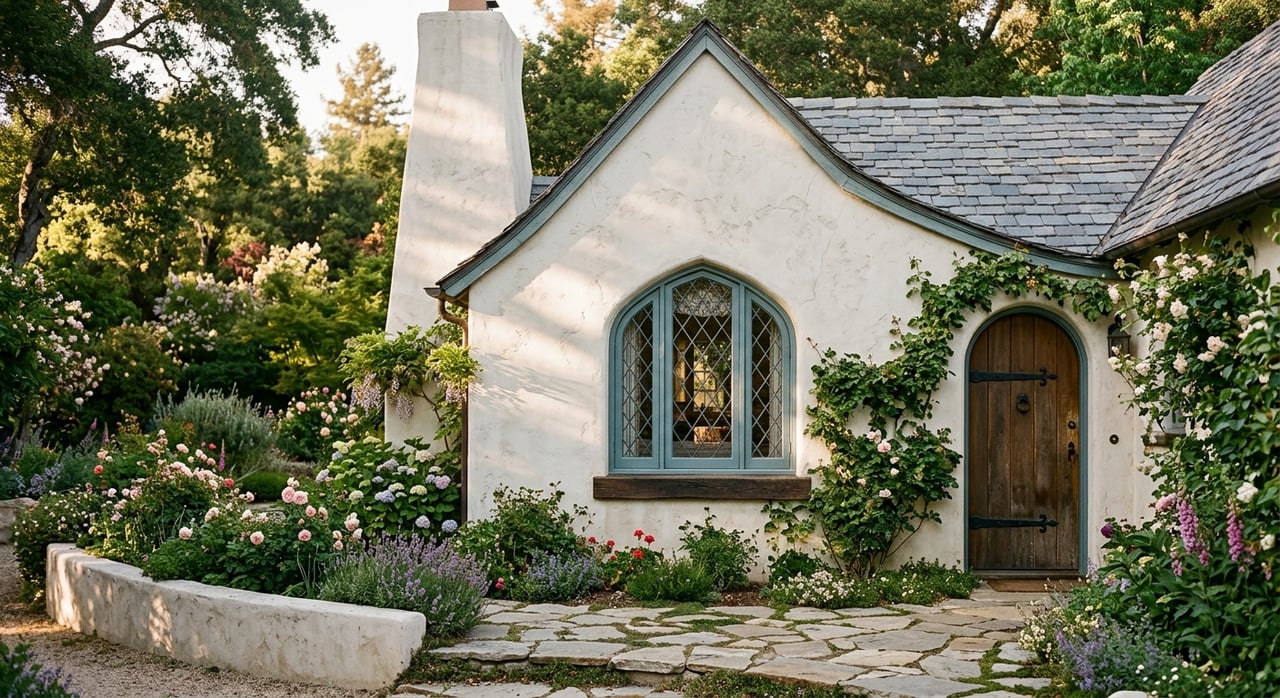
If Spanish Colonial Revival feels romantic, Storybook architecture feels theatrical. City planning materials describe Storybook as the most whimsical variation of Period Revival, and Los Feliz has some memorable examples.
This is the style for people who love asymmetry and charm. You may see steep multi-gabled roofs, rolled or pointed eaves, small multi-pane windows, mixed materials, turrets or dovecotes, and surfaces designed to feel hand-crafted or slightly aged.
In Los Feliz, examples include the Hlaffer-Courcier Residence on Glendower Avenue and the Snow White Cottages on Griffith Park Boulevard, a Storybook bungalow court associated with Disney animators. These homes help explain why the neighborhood can feel cinematic without feeling staged.
Why Storybook Homes Need a Careful Eye
Storybook houses are often visually complex. The roofline, trim, masonry, and window proportions do a lot of the design work, so even small exterior changes can have a big effect on the overall look.
If you are a buyer, that means original detailing matters. If you are a seller, preserving or highlighting those details can help your home read clearly to the right audience.
Storybook Clues to Watch For
- Steep, layered gables
- Deliberate asymmetry
- Small-paned windows
- Decorative masonry or textured surfaces
- Cottage-like scale and irregular massing
- A village-like or old-world feeling
Mid-Century Modern and Hillside Living
Los Feliz also has a strong modernist side. Mid-century and early modern homes here often emphasize post-and-beam structure, floor-to-ceiling glass, clerestory windows, low or flat roofs, and open plans that blur the line between indoors and outdoors.
These houses usually live very differently from Period Revival homes. They tend to feel brighter, more open, and more connected to daylight because the architecture is built around glazing, circulation, and site response.
In Los Feliz, public examples include the Sam and Jane Taylor House on Waverly Drive and the 1969 Wong Residence on Nottingham. Both are noted for open plans, broad glazing, and layouts that respond directly to the site.
Richard Neutra’s Lovell House offers another useful reference point. It is known as a steel-frame landmark that appears to float above a steep slope, which captures something essential about Los Feliz modernism: the design is often less about a front-facing facade and more about how the home meets the hillside, frames views, and manages light.
Mid-Century Features to Spot
- Post-and-beam construction
- Clerestory windows
- Large panes of glass
- Low or flat rooflines
- Broad overhangs
- Strong indoor-outdoor flow
- Open living, dining, and kitchen relationships
If you love clean lines and natural light, this is often the category that feels most immediate. But in Los Feliz, the best examples also have a strong relationship to the lot, landscaping, and view orientation.
Landmark Homes Beyond the Basics
One of the reasons Los Feliz stands apart is that it includes homes that go well beyond standard style labels. This is a neighborhood of architectural experimentation, not just a collection of attractive facades.
Hollyhock House at Barnsdall Art Park was conceived by Frank Lloyd Wright as the centerpiece of an artists’ colony in Los Feliz. It is now recognized as Los Angeles’s first UNESCO World Heritage Site.
Nearby, the Ennis House on Glendower Avenue is known for its handmade concrete textile blocks. Add in the Lovell House, and you start to see the bigger picture: Los Feliz has long attracted architecture that pushes ideas forward.
For a design-minded buyer, that heritage matters. It helps explain why even less famous homes in the neighborhood can have unusually thoughtful siting, materials, and spatial character.
Los Feliz Has Strong Multi-Family Design Too
Los Feliz architecture is not only about single-family homes. The neighborhood’s multi-family stock is a meaningful part of its design identity, especially in the Los Feliz Square Multi-Family Residential Historic District.
There, apartment houses, duplexes, triplexes, and fourplexes appear in styles ranging from Mediterranean Revival and Spanish Colonial Revival to Streamline Moderne, Minimal Traditional, and Mid-Century Modern. That variety gives you a wider design menu than many buyers expect.
If you are searching for character but do not need a detached house, this matters. In Los Feliz, courtyard-era charm and simpler postwar design can exist just blocks apart.
How Architecture Changes Daily Living
Style is not just visual. In Los Feliz, it often changes how a home feels from morning to night.
Spanish Colonial Revival and other Period Revival homes tend to feel more segmented and sheltered. Their atmosphere often comes from courtyards, arches, thicker walls, and controlled openings instead of uninterrupted openness.
Storybook homes often have the most irregular floor plans and the most complex roof geometry. That gives them personality, but it can also make changes feel more noticeable when someone alters windows, trim, or additions.
Mid-century homes are usually the brightest and most open. Post-and-beam construction, clerestories, and larger glass expanses are not just stylistic choices. They directly shape daylight, circulation, and the indoor-outdoor experience.
What Buyers Should Look For in Los Feliz
If you are shopping with architecture in mind, train your eye beyond finish materials and staging. In Los Feliz, the most meaningful design clues are often structural or spatial.
Look for the original window pattern, the rhythm of openings, built-ins, roof shape, and how the house sits on the lot. These features often tell you more about the architectural integrity of a home than a freshly updated kitchen ever could.
It also helps to consider how the house handles slope and privacy. On a hillside street, a great home may succeed because of its relationship to views, stair access, outdoor terraces, and daylight rather than because of square footage alone.
Smart Questions for Buyers
- Does the floor plan still reflect the original architectural intent?
- Have key details like windows, built-ins, and rooflines been preserved?
- Does the home feel site-responsive, especially on a slope?
- Are outdoor spaces integrated into the architecture?
- If updates were made, do they respect the home’s style?
What Sellers Should Know About Architectural Value
If you own a Los Feliz home, your architecture may be one of your strongest marketing assets. Design-minded buyers often respond to authenticity, and that starts with presentation.
That does not mean a home has to feel frozen in time. It means the details that make the architecture legible should be visible, photographed well, and supported by thoughtful storytelling.
For a Spanish Colonial Revival home, that may mean emphasizing arches, tile, ironwork, and courtyard flow. For a mid-century home, it may mean foregrounding glazing, beam structure, light, and the connection to outdoor living.
This is where design-led marketing can make a real difference. When your listing presentation reflects the home’s actual architectural identity, buyers are more likely to understand what makes it special.
Historic Review Matters in Los Feliz
Los Feliz includes individually designated historic resources and locally designated historic districts, so exterior work can be more regulated than it first appears. In Local Historic Districts and HPOZs, exterior renovations, additions, new construction, landscaping, and even paint may require additional review.
The city advises property owners to check with the district planner and ZIMAS before moving forward. If you are buying, this is an important part of due diligence. If you are selling, it can help you frame past improvements and future possibilities more clearly.
This is not a reason to avoid older or historic homes. It is simply part of understanding the neighborhood with open eyes.
Reading Los Feliz Like a Designer
The best way to understand Los Feliz architecture is to slow down. Notice the curve of the street, the grade of the lot, the mature trees, the distance from sidewalk to front door, and the way each home creates privacy, drama, or openness.
This neighborhood offers more than a checklist of styles. It offers a layered design language shaped by topography, preservation, and decades of architectural ambition.
If you are buying, that can help you find a home with real staying power. If you are selling, it can help you position your property with more clarity and confidence.
When you want help interpreting Los Feliz through both a design lens and a market lens, Sarah Minka Jackson brings the kind of curated perspective and hands-on guidance that can make the search or sale feel far more intentional.
FAQs
What architectural styles are most common in Los Feliz?
- Los Feliz is known for Spanish Colonial Revival, Mediterranean Revival, Storybook, Tudor-influenced homes, Mid-Century Modern, and a range of multi-family styles including Streamline Moderne and Minimal Traditional.
What should buyers look for in a Los Feliz architectural home?
- Focus on original window patterns, roof shape, built-ins, site response, and whether updates respect the home’s architectural style.
What makes Los Feliz Mid-Century Modern homes distinctive?
- Many Los Feliz mid-century homes feature post-and-beam construction, clerestory windows, large glass expanses, open plans, and strong indoor-outdoor flow shaped by hillside lots.
What defines Spanish Colonial Revival homes in Los Feliz?
- Common features include stucco walls, red-tile roofs, arched openings, wrought-iron details, enclosed patios, and layouts that emphasize shade, texture, and courtyard living.
Are renovations in Los Feliz historic areas more regulated?
- Yes. In local historic districts and HPOZs, exterior changes such as additions, landscaping, and even paint may require review, so it is important to verify requirements before starting work.
Does Los Feliz have architecturally notable multi-family housing?
- Yes. The neighborhood includes apartment houses, duplexes, triplexes, and fourplexes in several historic styles, especially within the Los Feliz Square Multi-Family Residential Historic District.